
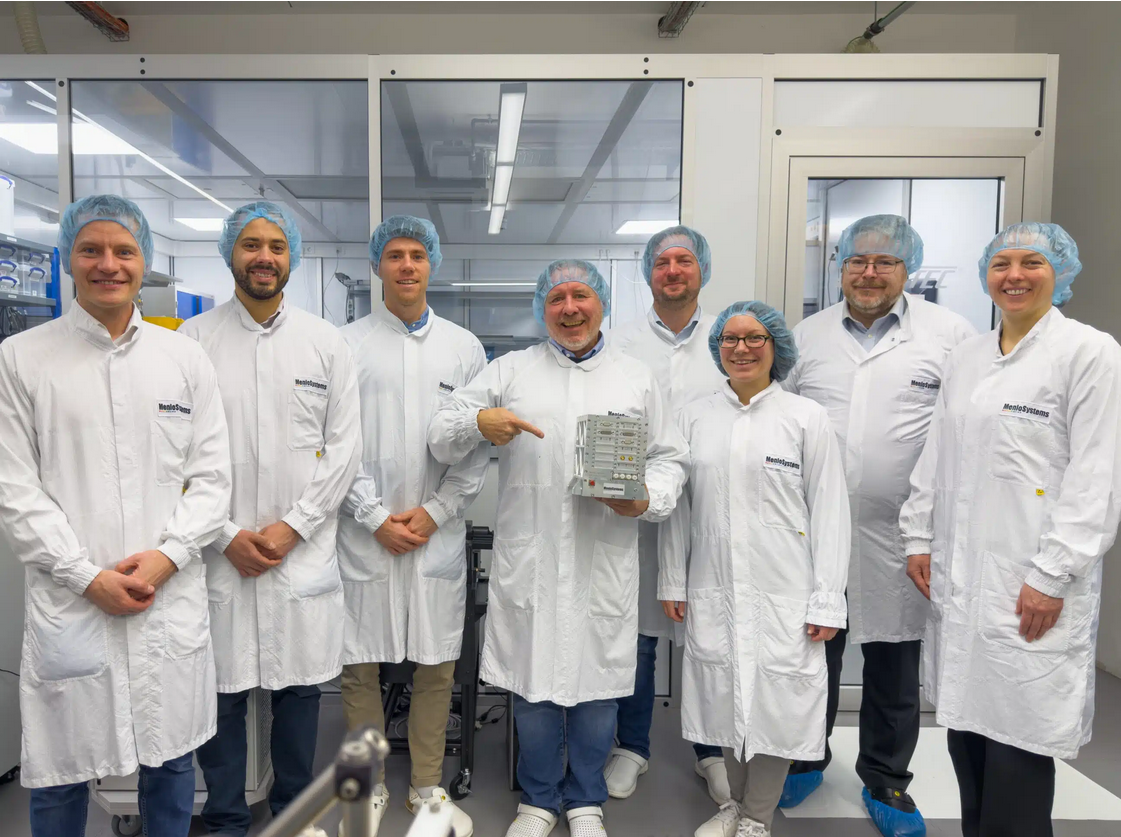
Menlo Systems has been commissioned to supply the optical frequency comb for the CRONOS (Compact Rubidium Oscillator for Navigation Systems Onboard a Satellite) mission, led by the Ferdinand-Braun-Institut (FBH) and Humboldt-Universität zu Berlin (HU Berlin), which aims to demonstrate one of the world’s first miniaturized optical clocks operating in space.
The CRONOS payload combines cutting-edge photonic and laser technologies to achieve ultra-precise timing in a compact, space-qualified format. Its core consists of a miniaturized rubidium two-photon optical frequency reference, developed by FBH and HU Berlin, which operates at 778 nm and fits within a package of less than half a liter. Menlo Systems’ space-grade optical frequency comb supplies, controls, and characterizes this optical reference, transferring the exceptional stability of the optical transition to radio frequencies, where it can be compared with a GPS-stabilized reference oscillator. With a volume of less than 7 L and power consumption under 55 W, including control electronics for the optical reference, this comb is deployment-ready for a microsatellite-based mission.
The frequency comb is based on Menlo’s patented figure 9® mode-locking technology, known for its ultra-low noise, robustness, and long-term stability, which are essential features for space applications. The CRONOS project marks an important step toward compact optical clocks for next-generation satellite navigation and deep-space missions, potentially improving global positioning accuracy and timekeeping far beyond current microwave standards. With its central role in this mission, Menlo Systems further reinforces its position as a leading supplier of frequency combs and a key enabler of optical clock technology for space applications.
Funded by the German Space Agency (DLR) and the Federal Ministry for Economic Affairs and Climate Action (BMWK), CRONOS is a collaboration between FBH, HU Berlin, Technische Universität Berlin, and Menlo Systems.